


The Option Trader’s Hedge Fund: A Business Framework for Trading Equity and Index Options
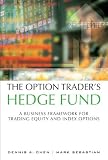
In this book, a hedge fund manager and an option trading coach show you how to earn steady, reliable income selling options by managing your option trades and running your option portfolio as a real business with consistent, steady returns. Packed with real-world examples, the authors show you how to manage your own “one man” hedge fund and make consistent profits from selling options by applying the basic framework and fundamental business model and principles of an “insurance company”.

List Price: $ 49.99
Price: [wpramaprice asin=”0132823403″]
[wpramareviews asin=”0132823403″]

A “must read” for anyone using options in their investing or trading,
I just finished reading through Dennis and Mark’s book and was struck by the fact that the authors tackled some rather complex subjects, but managed to keep the discussion at a level where it should be easily accessible to anyone with an intermediate understanding of options.
As such, this book represents a excellent transition point for those traders who have begun to learn the fundamentals of options and are now ready to begin integrating options into all of their trading and investment activity.
What this book provides is an overall blueprint for an individual to set up and manage their investment and trading capital much like an insurance company might sell policies, collect premiums, and manage risks. In fact, this is the premise laid out in the first chapter. The business model for “The One Man Insurance Company” (or TOMIC, as it is referred to within the book) involves the use of short option sales to generate cash while using long premium to hedge, limit and manage risk.
Where The Option Trader’s Hedge Fund separates itself from prior books is by taking a look deeper into the how’s and why’s of structuring trades. Rather than focusing upon market prices, TOMIC drills into the implied volatility of options to seek out advantages that might be exploited. It’s the focus upon implied volatility that is likely to cause light bulbs to flash on above the heads of some readers. Using the discussion on volatility as a back drop, the authors then provide a run down of the five most commonly used option strategies within TOMIC along with suggested criteria for when these trades make sense and when they do not.
There is also “nuts & bolts” advice about how to obtain better trade executions and demonstration of how these seemingly small savings can add up to rather significant amounts for an actively managed fund. The lesson here is that even if you’re trading a small account on a limited basis, developing the skills now will pay much larger dividends as your account size and trade activity grows.
Common questions are answered, such as a break down of how much capital a trader should have before trying to trade full-time and how a trader can protect their portfolio against sudden market declines such as the now infamous “Flash Crash”. In short, this book represents a compilation of insights and advice that is not easily or quickly acquired. It’s definitely a “must read” for the developing options strategist and trader.
Christopher Smith
TheOptionClub.com
Was this review helpful to you?

|Good Book but Too Brief On Topics,
I am not a professional options trader but learning. The concept of comparing options trading to an insurance company makes a lot of sense when you think about it. My main complaint is that the book often rushes through a topic without adequately explaining it. I kept getting the feeling that this book was just thrown together. Most of Part III is actually postings from Sebastian’s blog. The book covers some topics such as unit options that are new and potentially very useful to me. Aso some of the blog postings are very useful. However, the book was originally listed as being over 300 pages long; it would have been better to me if the authors had kept writing with more examples.
Was this review helpful to you?

|good framework, short on details,
Apart from the very good comparison with the (re)insurance model (chances are an experienced trader implicitly follows this model) and a trading framework (more of an outline of the framework listing a collection of questions), an experienced reader/trader will be hard pressed to find any new information or insights for new trading strategies. Being a devoted reader of Jeff Augen, I was disappointed not to find any new valuable information, given his endorsement of the book.
For an beginner to intermediate level reader, the authors provide an excellent comparison to the insurance model and then provide a series of questions that can help create a trading plan. The experienced trader is not likely to benefit for the most part of the first 7 chapters. The authors provide a good summary of key strategies (nothing new) with a few insights on timing of the trades and good discussions on gamma scalping, impact of weekend, skews, etc. However, the details are sketchy and the complexity of the discussions very haphazard – intermediate readers will find the discussions of the more complex spread trades unnerving and will need additional references. An experienced trader will be able to use the last 3-4 chapters as good revision and may pick up an insight or two.
Despite the sometimes confusing approach to the topics (unsure of what audience to target the book to?), sketchy details, a rather poor citation/ recommended reading list, the last few chapters are likely to offer an experienced trader with few insights on mechanics of gamma scalping and related topics and provides an opportunity to reassess one’s trading framework. 3.5*
Was this review helpful to you?

|