


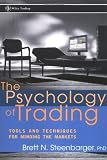
The Psychology of Trading: Tools and Techniques for Minding the Markets (Wiley Trading)
“The one, only, and by far the best book synthesizing psychology and investing. In addition to providing modern, scientific knowledge about psychology, this book provides a mirror into the mind and wide breadth of knowledge of one of the leading practitioners of brief and effectual cures. Will help to cure your trading and your life.”
-Victor Niederhoffer, Chief Speculator, Manchester Investments
Author, The Education of a Speculator and Practical Speculation
“How refreshin

List Price: $ 50.00
Price: [wpramaprice asin=”B000QEVMDO”]
[wpramareviews asin=”B000QEVMDO”]
Related Trading Psychology Products

Well researched and written, but not for the mass,
The author’s M.D. counsellor-trader identity did help him making this an uncommon trading psychology book full of “highly trading relevant” counselling records from both trader and non trader patients. The catch is: if you are not interested in or equipped with an intermediate level of knowledge about psychology or counselling, I doubt very much whether you can finish reading this 300 page book till its end.
To let you have a better grasp of my “worry” mentioned above, I would like to quote something from the last or conclusion chapter, which the author regarded them as the 11 major themes explored in his book.
1. Behavior is patterned.
2. Your trading patterns reflect your emotion patterns.
3. Change begins with self observation
4. Problem patterns tend to be anchored to particular states. (When you enter a particular state thru emotional, physical, or cognitive activity, you tend to activate the behavioral patterns associated with that state.)
5. Our normal states of mind, which define most of our daily experience, lie within a restricted range of our possibilities. (Your immersion in daily routine keeps you locked in routine mind states)
6. Most trading occurs in a limited range of states, trapping traders in problem patterns. (Traders tend to place greater emphasis on the data they process than on the ways in which they process those data.)
7. People in general, and traders specifically, enact solutions as well as problem patterns.
8. Eliminating emotions is not necessarily the secret to improving trading. (Traders can utilize positive emotional experiences to identify constructive solution patterns and to create an anchoring of new, positive patterns.)
9. Success in the markets often comes from doing what doesnt come naturally.
10. The intensity and the repetition of change efforts are directly responsible for their utlimate success.
11. Trading success is a function of possessing a statistical edge in the markets and being able to exploit this edge with regularity.
In short, if you can appreciate or at least have a slight idea of what the above 11 themes try to preach, this book suits you well. Otherwise, please give it a pass.
Was this review helpful to you?

|a FAR CUT above anything else out there…,
I am a full-time, intensely dedicated trader. I can say that many individual paragraphs in this book contain more useful information, advice, and insight than the TOTAL of all other books I’ve read on trading. First: the author is SMART, VERY experienced with trading, and the perfect combination of an original thinker and a well-informed intellectual in his field. He has an obvious gift for psychology and therapy, and a real hook for trading. Although the book is literally overflowing with all sorts of gems, the center of it, and the brightest gem of all surrounds the concept of “brief therapy.” Through 10 or so excellent therapy stories he shows us several ways to “get outside ourselves” and observe what we’re really up to; and then how to cleverly “shift” who we are to more productive patterns. He does all this both within and beyond the particulars of trading. This book can help you achieve a clarity directly appropriate to trading in DAYS, that without it–and if you were quite perceptive!–would have seemed like a lifetime’s work. I can’t recommend this book highly enough; and I’ve never written a review and don’t plan to write another–AND, I’m kicking myself because I’d really prefer that other traders DIDN’T read it!
Was this review helpful to you?

|a fascinating trip that will help you in all areas of life,
The Psychology of Trading is one of those books where you will make a lot of discoveries about yourself and about your life, if you are paying attention, that all tie into trading.
Steebarger is a psychologist specializing in “brief therapy” and also an active trader. The book has chapters that discuss an in-depth story of a patient, and draw lessons from that story about life, cognition, and trading.
It is an awesome book. I have read Douglas and I have Ari Kiev’s book which I will read one of these days, but I can’t see how it can top Steenbarger’s.
Steenbarger says that we have many personalities, and he shows you how you can identify which personality is doing what, and trigger the “Observer” in you, a part of you that is watching and that can see the truth of what you are doing and why you are doing it. This isn’t as Zen as it sounds. And Steenbarger has technique after technique in each chapter, so it isn’t a bunch of generalizations and observations.
The first technique (which I have done for some months now and read that Larry Connors and Linda Raschke also do and you probably do too) is to keep a detailed trading journal with your thoughts, feelings, what is happening, why you are taking a trade, etc.
The second technique is to excercise in the morning (he does stretching and some calisthenics) and then talk out loud and explain each of your trading plans. Something about talking out loud and explaining your plans lets your brain process differently and he says you can identify what is really good, find holes and see potential traps or things you haven’t thought through.
I am on the fourth chapter and I just love this book.
Was this review helpful to you?

|